
①The main production process of hot-rolled seamless steel pipe (△main inspection process):
Tube blank preparation and inspection△→tube blank heating→piercing→tube rolling→steel reheating→fixed (reduced) diameter→heat treatment△→finished pipe straightening→finishing→inspection△ (non-destructive, physical and chemical, Taiwan inspection)→warehousing
②The main production process of cold-rolled (drawn) seamless steel pipe:
Billet preparation→pickling lubrication→cold rolling (drawing)→heat treatment→straightening→finishing→inspection
Cold drawing and hot-rolling are the two methods used to manufacture general seamless steel pipes. Cold-rolled seamless steel pipe manufacturing is generally more complicated than hot rolling. If the surface does not respond to cracks during the sizing test, the round tube will be cut by a cutting machine into a billet with a length of about one meter. Then begin the annealing process. Annealing should be pickled with an acidic liquid, and watch for blistering on the surface during pickling. If there is a lot of blistering, it indicates that the steel pipe's quality does not meet the corresponding standard. Cold-rolled seamless steel pipe appears to be shorter than hot-rolled seamless steel pipe. The cold-rolled seamless steel pipe has a thinner wall than the hot-rolled seamless steel pipe, but the surface looks brighter than the thick-walled seamless steel pipe, and the surface is not too rough. Much rougher, and the caliber has fewer burrs.
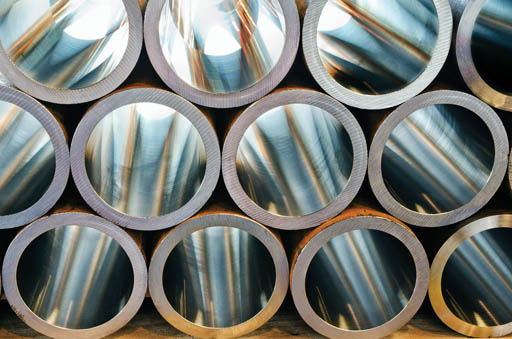
In general, hot-rolled seamless steel pipe is delivered in the hot-rolled state after heat treatment. The hot-rolled seamless steel pipe must be strictly hand-selected by the staff after the quality inspection. The surface should be oiled after the quality inspection, followed by several cold-drawing experiments, and the perforation experiment should be performed after the hot-rolling treatment. If the perforation's diameter is too large, it should be straightened and corrected. After straightening, it is transferred by a conveyor to the flaw detector for flaw detection experimentation before being labeled and arranged in specifications and placed in the warehouse.
Round tube blank→heating→piercing→three-roller skew rolling, continuous rolling or extrusion→tube removal→sizing (or reducing)→cooling→straightening→hydrostatic test (or flaw detection)→marking→storage seamless steel pipe It is made of steel ingots or solid tube blanks through perforation to make capillaries, and then hot-rolled, cold-rolled or cold-drawn. The specifications of seamless steel pipes are expressed in millimeters of outer diameter * wall thickness.
The outer diameter of a hot-rolled seamless pipe is typically greater than 32mm, with a wall thickness ranging from 2.5 to 200mm. The outer diameter of a cold-rolled seamless pipe can reach 6mm, with a wall thickness of 0.25mm, and a thin-walled pipe reaching 5mm. Hot rolling has greater dimensional accuracy than rolling.
In general, seamless steel pipes are made of 10, 20, 30, 35, 45, and other high-quality carbon steels, as well as 16Mn, 5MnV, and other low-alloy structural steels, or hot-rolled or cold-rolled 40Cr, 30CrMnSi, 45Mn2, 40MnB, and other combined steels. For fluid transportation pipelines, seamless pipes made of low-carbon steel, such as 10 and 20, are commonly used. Mechanical parts, such as stressed parts of automobiles and tractors, are made from 45, 40Cr, and other medium carbon steel seamless pipes. Seamless steel pipes are typically used to ensure strength and flattening tests. Hot-rolled steel pipes can be delivered hot-rolled or heat-treated, whereas cold-rolled steel pipes can only be delivered heat-treated.
Hot rolling, as the name implies, has a high temperature of the rolled piece, so the deformation resistance is small, and a large amount of deformation can be achieved. Taking the rolling of steel plates as an example, the thickness of the continuous casting slab is generally about 230mm, and after rough rolling and finishing rolling, the final thickness is 1~20mm. At the same time, due to the small width-to-thickness ratio of the steel plate, the dimensional accuracy requirements are relatively low, and the plate shape problem is not easy to occur, and the main control is to control the crown. For those with organizational requirements, it is generally realized by controlled rolling and controlled cooling, that is, controlling the opening temperature and final rolling temperature of finishing rolling. Round tube billet → heating → perforation → heading → annealing → pickling → oiling (copper plating) → Multi-pass cold drawing (cold rolling) → billet tube → heat treatment → straightening → hydraulic test (flaw detection) → marking → storage.

TIANJIN YUANTAI DERUN PIPE MANUFACTURING GROUP CO., LTD
